Zero-Repass Batch Protection
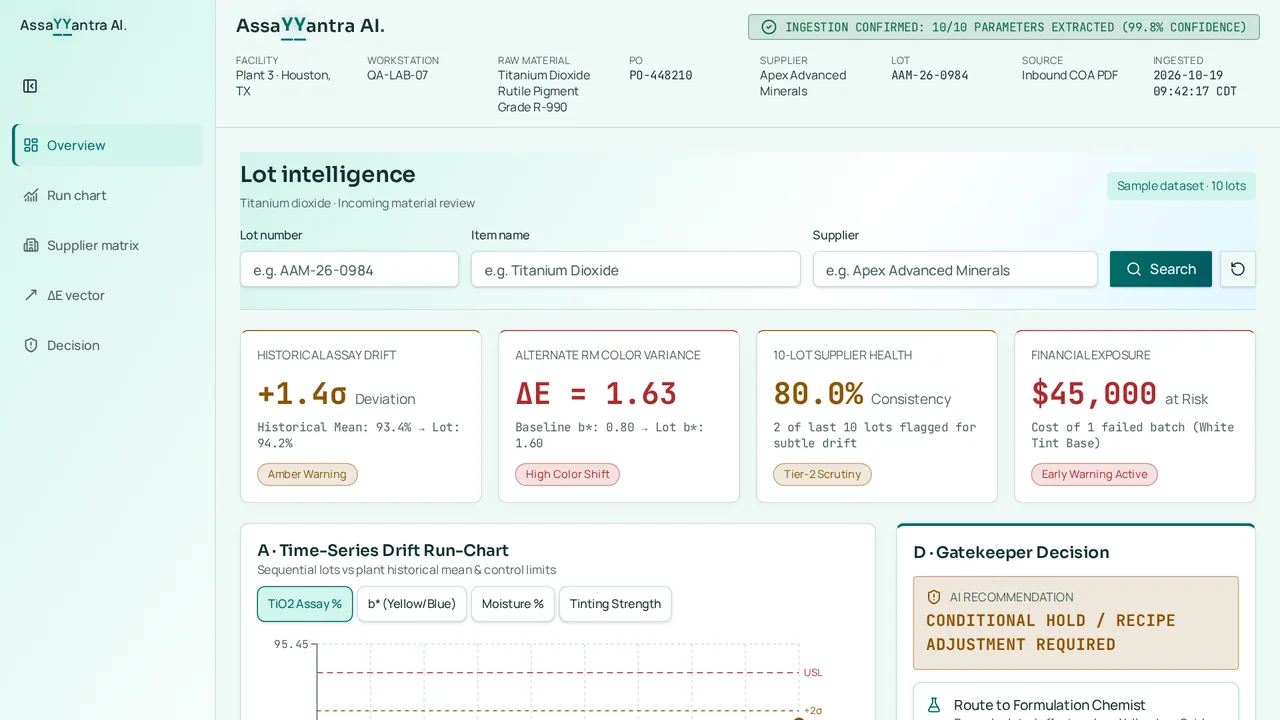
Compare incoming lots against your history to stop batch restarts and extra production passes before mixing begins.
Cut COA or approved lot review labor by 90%, safely use Alternate Supplier lots, and stop batch restarts early.
Who it's for
Cutting operational rework costs, wasted tank time, and batch restarts.
Preventing off-shade repasses from shifting L, a, b, c color values.
Needing instant email alerts when Supplier B drifts from Supplier A.
Reducing labor hours by up to 90% on incoming COA verification.
Outcome pillars
Compare incoming lots against your history to stop batch restarts and extra production passes before mixing begins.
Quantify exact variance between Supplier B and Supplier A in under 5 minutes to safely use lower-cost alternates.
Automatically email your QC representative the moment massive baseline drift or Supplier B variance is detected.
Extract assay percentages, viscosity curves, and L, a, b, c values without templates to eliminate manual review bottlenecks.
Audit 50 past supplier COAs in 48 hours to uncover hidden drift without any IT installation.
Before & after
Current process
With AssayYantra AI
90%
less review labor
<5 min
to measure supplier variance
40%
reduction in batch reworks
How it works
Drop 50 past COAs and master specs into a secure folder to get your 48-hour drift report.
Walk through the hidden baseline drift found in your past lots and agree on the thresholds that matter to your team.
Complete a 1-hour tutorial and auto-forward incoming or alternate vendor COAs to your dedicated system email.
Automatically email your QC representative when Supplier B drifts from Supplier A, preventing repasses and batch restarts.
Over your 90-day live pilot, extend monitoring to more materials and suppliers while cutting manual review labor.
Why it's different
Tracks two baselines: your material history and Supplier B lots against original Supplier A standards.
Triggers automatic email warnings to QC representatives before drifting lots cause batch restarts or repasses.
Cuts manual COA verification labor by up to 90% without requiring rigid OCR templates or IT setup.
FAQ
When an alternate is suggested or forwarded, it automatically emails your QC representative detailing the exact drift from Supplier A.
It cuts manual QA document processing time by up to 90% and calculates alternate lot variance in under 5 minutes.
By catching over 80% of borderline drift trends early, you adjust recipes before mixing instead of reworking failed tanks.
No. You simply drop 50 past COAs and master specs into a secure shared folder with zero integration required.
If we do not find at least three lots outside your historical range, you pay nothing and keep the report.
Yes. It extracts assay percentages, viscosity curves, and L, a, b, c color values without rigid OCR templates.
In the first 48 hours, you will uncover the exact baseline drift hiding in your past 50 supplier lots. Over your 90-day live pilot, you will cut manual COA review labor by up to 90%, automatically alert your QC representative via email whenever Supplier B drifts from Supplier A, and eliminate the costly batch repasses and restarts that drain operational margins.